Richard B. Miller was born in September 1853 in Illinois to Robert B. Miller and Mary Ann Austin Miller. His father was a grocer, and Richard also worked in the grocery business. The 1880 census recorded him as working in the grocery field in Prairie, Illinois, and noted that he was lame from a broken leg.On September 30, 1880, Richard married Lorinda Florence Reeder in McLean County, Illinois.
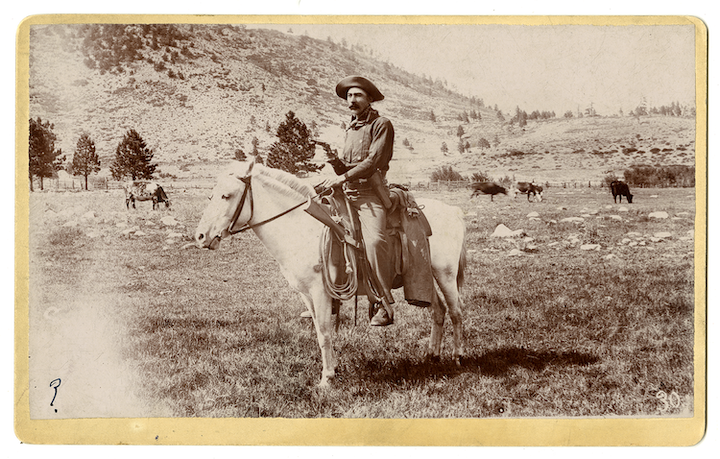
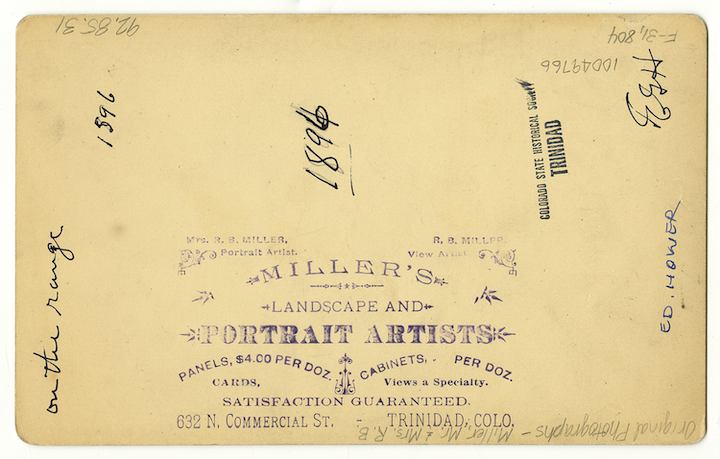
Mr. and Mrs. R. B. Miller, photographers. Unidentified man on horseback, 1896. History Colorado, 92.85.31Note that Mrs. R. B. Miller was the portrait artist and her husband was the view artist. Panel cards were $4.00, while the price for cabinet cards was left blank, as prices often changed due to competition between photographers.
Lorinda Florence Reeder was born on a farm in January 1855 in Warren County, Ohio, to George Washington Reeder and Jane Thompson Reeder.She worked as a teacher and dressmaker before her marriage.
Details of the next twelve years of their life are uncertain. Around 1892, the Millers and their two children had moved to Trinidad, Colorado.Mrs. Miller operated a photo studio, while her husband ran a fruit-and-candy store. Later, they both worked at the studio, and they remained there until 1897.
In the fall of 1897, Miller relocated his studio to Gaylord, Kansas. He spent the next decade in Kansas, moving among small towns, and sometimes operating a photo car. Mrs. Miller ran the studio when her husband traveled. In 1901, the family moved to Atchison, Kansas, where he worked first as a photographer and later as a house painter.By 1909, the Millers lived in Beloit, Kansas. In the 1910 federal census, Mrs. Miller is listed as a photographer and her husband as a house painter. In 1917, they left Kansas for Spokane, Washington, where their daughter and her family lived.
Richard B. Miller passed away on January 4, 1925, in Salina, Kansas.He was buried at Gypsum Hill Cemetery in Salina. Mrs. Miller spent the final years of her life in Riverside, California. She died on May 20, 1945, and is buried at Olivewood Cemetery in Riverside.
Thank you to the staff at History Colorado, including Jori Johnson, Ann Sneesby-Koch, Aaron Marcus, and Joy Saliu, for providing access to their photo collection and for providing scans.
Dana Boardman Chase was born on September 20, 1847, in Waldo, Maine, to John A. Chase and Lydia Sylvester Lane Chase. By 1860, the family was living in Atchison, Kansas, where John A. Chase operated a photography gallery. His son, Henry A. Chase, also practiced photography in that city. Dana most likely learned the trade from his father.On September 16, 1863, at age sixteen, Chase enlisted in the Union Army as a private in Company F of the Kansas 13th Infantry Regiment. He served on garrison duty in Arkansas from March 1864 to January 1865.In March 1865, the regiment performed guard and provost duty at Little Rock until it was discharged in June.
Duhem Bros., photographers. Stock Growers Bank, Pueblo, CO, 1875. See Erie Photo sign at bottom right. Denver Public Library, Western History, x18626.
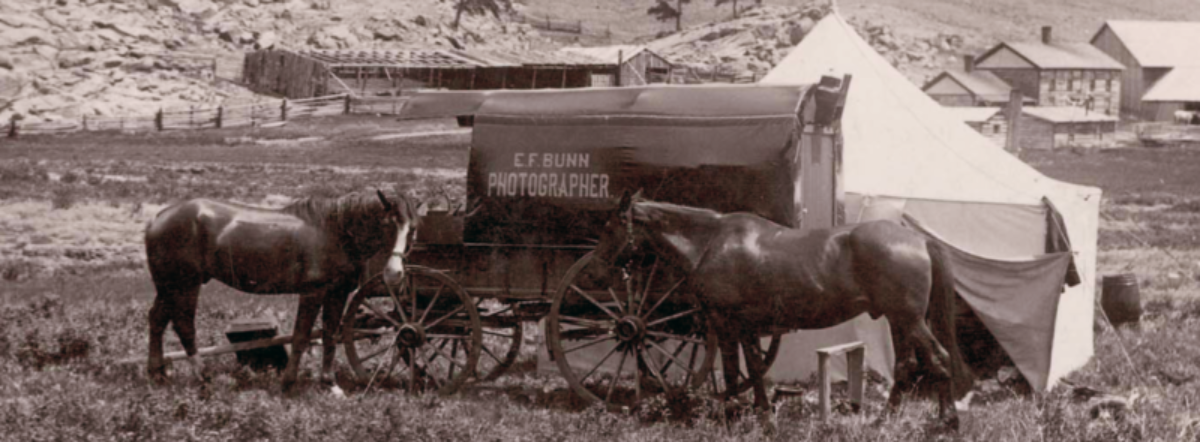
In the spring of 1873, Dana and his father arrived in Colorado. They worked together as Chase & Chase. A year later, after his father returned to Kansas, Dana and Henry O. Morris established the Erie Photographic Company in a red and white tent between Jordan’s store and the Lindell Hotel in Pueblo, Colorado. In January 1875, the men rented gallery space above Jordan’s store. That fall, they moved their gallery above Stockgrowers’ Bank, on Santa Fe Avenue.
In November 1875, Dana’s father returned to Pueblo for health reasons. He resumed work in the photography field, operating a photo car out of Las Animas, Colorado.
On May 11, 1876, Pueblo’s Colorado Daily Chieftain reported that “Mr. D. B. Chase and Henry O. Morris, of the Erie Photograph gallery, start out this morning in a photograph car for Cañon City and other points in southern Colorado, to take photograph and landscape views of mountain and plain—not forgetting Cañon’s big sideshow, the grand cañon. Messrs. Chase and Morris, are artists in their line of business, and we commend them to our friends all over the country.Mr. G. G. Withers, of the CHIEFTAIN corps, accompanies the out-fit as “special artist on the spot,” to do up accidents, arsons, murders, neck-tie festivals, Beecherism, or any other kind of ism, for the paper of vim, vinegar, vitriol and enterprise.”
D. B. Chase, photographer. Trinidad, Colorado from Simpsons Rest, ca. 1880. Amon Carter Museum of American Art, Fort Worth, Texas.
In the fall of 1876, Chase worked out of a tent gallery in Saguache, Colorado, a supply town for miners and settlers along theOld Spanish Trail, for about a month, making portraits.He then moved his tent to Lake City.On December 1, 1876, he married Ella May Burt in Saguache.They had five children, and one, Gladys, died a few days before her third birthday.He returned to Saguache in the summer of 1877.Later that year, he opened galleries in the mining towns of Alma and Del Norte, Colorado.The Del Norte business was a partnership with Danforth N. Wheeler. Dana’s father passed away on December 18, 1878, in Pueblo, leaving his estate to his wife and giving each of his children five dollars.
D. B. Chase, photographer. View of a Denver and Rio Grande Railway train, with a locomotive and mixed cars, at Mule Shoe Bend on Veta Pass (La Veta Pass). Denver Public Library, Z-5482
Chase operated the leading gallery in Trinidad for more than a decade. In 1884, he opened a branch gallery in Santa Fe, New Mexico, on the west side of the Plaza, selling local views to tourists. He advertised in Santa Fe’s Spanish-language newspapers, highlighting his experience with the Mexican community. During this period, he also made many portraits of Native Americans. He hired Eben B. Headley as the studio’s photographer. He maintained studios in New Mexico through 1891.
In 1888, he divorced Ella May and later that year married Belle Bybee in Santa Fe.Bybee was an experienced photographer, who had operated her own studio in Harper, Kansas.It is likely that Belle assisted Dana in the studio.In July 1889, Mr. and Mrs. Dana traveled to the Taos Valley to view pueblo ruins and cliff dwellings, leaving Frank E. Scott, Chase’s studio manager in Trinidad, in charge of the Santa Fe gallery.
Scott took over Chase’s new studio in San Pedro, New Mexico, with all the finishing completed in the Santa Fe studio.
In December 1890, Chase placed an advertisement in the St. Louis and Canadian Photographer, offering his gallery for sale, describing it as “cabinets $6 per dozen; best climate for cure of pulmonary troubles in the United States; military post with elegant band.” Chase sold his Santa Fe gallery to Thomas J. Curran.
My next post will examine the later years of Chase’s career.
The Aultman Studio was a fixture in Trinidad, Colorado, for more than 100 years. It was started by Oliver E. Aultman in 1890, and he was later joined by his brother, Otis. After Oliver Aultman’s death in 1954, his son Glen ran the studio until his own death in 2000. The Aultmans produced very artistic portraits in a town of just over 5,000 residents. I will post more information about the Aultmans at a later date.
For Black History Month, I have selected one portrait from Aultman’s original negatives held by History Colorado.
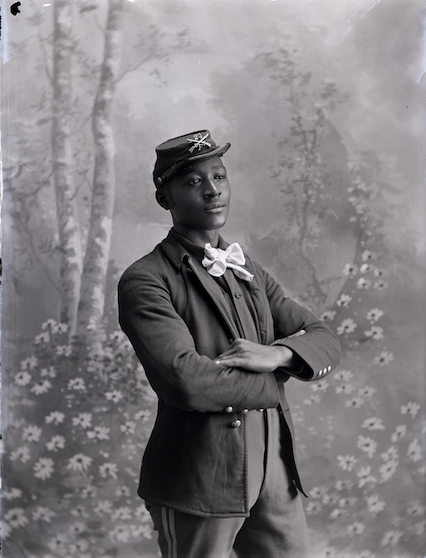
Oliver E. Aultman, photographer. Private William W. Cobbs, 1894. Scan from original negative. History Colorado, object id: 2001.41.660.
William W. Cobb (b. c. 1874-1949), sometimes spelled Cobbs, served as a Buffalo Soldier in the 24th Infantry Regiment, Company F, stationed in New Mexico.
History Colorado uncovered the following information during the course of cataloging this. photograph: The 24th was commanded by Colonel Zenas R. Bliss (1835-1900) to keep peace in the southwest after the American Indian Wars. Cobb served with the 24th from 1891 until he was discharged in 1896. During the Pullman Strike of 1894, the 24th was one of the regiments sent to Trinidad to help subdue striking railroad workers. This brief stay in Trinidad would have given Cobb the chance to have his portrait taken by the Aultman Studio.
Cobb was born around 1874 in North Carolina. After his military service, he lived in Vincennes, Indiana, where he worked as a janitor at City Hall and later at the First National Bank. In 1901, he married a woman named Hattie, and they had a daughter, Ethel. In 1920, the couple divorced.
Shortly after his divorce, Cobb moved to Washington, D.C. In September 1928, he married Ruth L. Prather. Cobb died at the National Soldiers’ Home in Washington, D.C. He is buried with a military headstone at Arlington National Cemetery in Arlington, Virginia.