Oliver Aultman’s Portrait of a Buffalo Soldier

The Aultman Studio was a fixture in Trinidad, Colorado, for more than 100 years. It was started by Oliver E. Aultman in 1890, and he was later joined by his brother, Otis. After Oliver Aultman’s death in 1954, his son Glen ran the studio until his own death in 2000. The Aultmans produced very artistic portraits in a town of just over 5,000 residents. I will post more information about the Aultmans at a later date.

For Black History Month, I have selected one portrait from Aultman’s original negatives held by History Colorado.
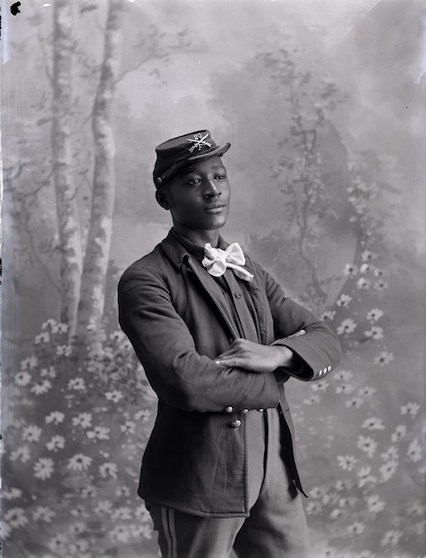
Portrait of Cobbs
Oliver E. Aultman, photographer. Private William W. Cobbs, 1894. Scan from original negative. History Colorado, object id: 2001.41.660.

William W. Cobb (b. c. 1874-1949), sometimes spelled Cobbs,  served as a Buffalo Soldier in the 24th Infantry Regiment, Company F,  stationed in New Mexico.

History Colorado uncovered the following information during the course of cataloging this. photograph:  The 24th was commanded by Colonel Zenas R. Bliss (1835-1900) to  keep peace in the southwest after the American Indian Wars. Cobb served with the 24th from 1891 until he was discharged in 1896. During the Pullman Strike of 1894, the 24th was one of the regiments sent to Trinidad to help subdue striking railroad workers. This brief stay in Trinidad would have given Cobb the chance to have his portrait taken by the Aultman Studio.

Cobb was born around 1874 in North Carolina. After his military service, he lived in Vincennes, Indiana, where he worked as a janitor at City Hall and later at the First National Bank. In 1901, he married a woman named Hattie, and they had a daughter, Ethel. In 1920, the couple divorced.

Shortly after his divorce, Cobb moved to Washington, D.C. In September 1928, he married Ruth L. Prather. Cobb died at the National Soldiers’ Home in Washington, D.C. He is buried with a military headstone at Arlington National Cemetery in Arlington, Virginia.

See more about the Aultman Studio .

Thank you to History Colorado staff Jori Johnson and Aaron Marcus.


Meet the Brown Family


C. M. Marsh, photographer. The Brown Family, 1890s. City of Greeley Museums, Permanent Collection.

The Brown family sat for their portrait at Clark M. Marsh‘s Greeley studio in the 1890s. Greeley had a population of around 2,400 in 1890, and only a small number of Black families lived in the town.

1880
1880 Federal Census, Greeley, CO

The 1880 federal census provides information about the family. Elvira Brown was a single mother, born around 1851 in Michigan. She worked as a laundress. Her eldest son, William, was born in the New Mexico Territory, and her three other children—Ernest, Bertha, and Belle— were born in Colorado. The children’s father was born in the Indian Territory. Brown lived with her widowed mother, Charity Davis, and a brother and sister. Elvira’s two eldest children, and her brother and sister, attended school.

In the 1885 Colorado census, the Brown family lived on Seventh Avenue in Greeley.  All four children attended school.  Elvira’s mother and siblings did not live with the family.

In 1900, Ernest Brown worked as a porter in Greeley.  On August 3, 1907,  Brown married Violet Wright in Las Animas, Colorado.  He worked as a porter at a lodging house, where his wife was a chambermaid.

Bertha Brown married Benton Davis, a porter, on July 1, 1898, in Boulder, Colorado.   By 1900, the couple lived in Leadville, Colorado, with their two-year-old daughter.   Her sister Belle resided with them, working as a laundress at the Saddle Rock Restaurant. Elvira also lived in Leadville.

The family lived in Leadville through 1903, but I could not find any record of them after that date.  If anyone has more information about the Brown family, please let me know.

Thank you to Miranda Todd at the Greeley Museum for providing the names of the Brown children.