A. H. Jones, Grand Junction Photographer

Archie Hull Jones was born in Davenport, Iowa, on March 3, 1873, to Theodore M. Jones, a photographer, and Mary Eliza Rice Jones.  The family moved to Moline, Illinois, in the late 1870s, where T. M. Jones continued working as a photographer.  

A decade later, the Jones family moved to Grand Junction, Colorado.  Archie’s father was the vice president at the First National Bank of Grand Junction.  Archie secured a position as an assistant bookkeeper at the bank.  On April 20, 1892, Archie married Gertrude Alice Quinn in Salt Lake City. 

Women with instruments
A. H. Jones, photographer. Three unidentified women with musical instruments. Collection of the author.

In December 1892, Archie and his wife moved to Moline, where Archie studied photography with E. E. Mangold.  The following April, the Joneses returned to Grand Junction.  Archie bought Mary Dudley’s photographic studio in the Bonnell block.  He updated the studio’s painted background and learned to use flashlight to illuminate interior spaces when photographing events outside the studio or in private homes.  

Archie had a lively group of friends he would bicycle with and go hunting.  After one hunting trip, Jones made a souvenir featuring small mounted photographs showing camp scenes and men in their hunting clothes.  He was a member of a local bicycling club and was appointed local consul of the national organization, the League of American Wheelmen.

In early 1896, Jones started prospecting for ore in Leadville, Colorado, and near Westwater, Utah.   In May of that year, Miss Florence Potter, a young woman from California, opened a photo studio in the space Jones had used. Even after closing his studio, Jones joined a new camera club that had formed in Grand Junction in the summer of 1896, comprised of nearly twenty amateur members.  

Jones spent most of his career as a mining engineer based in Salt Lake City, Utah. He passed away on May 7, 1943, at his son’s home. His remains are buried in Mount Olivet Cemetery in Salt Lake City.

Mary Dudley Revisited

In 2021 I wrote a post about Mary Dudley.    At that time, I had not seen any work from her studio in Grand Junction.  This cabinet card photograph of two unidentified men in western wear shows off her talent as a studio photographer.  Like most 19th century photographers, Dudley’s mount does not include her first name.   In Grand Junction she used “M. Dudley” and  her Boulder, Colorado mounts just “Dudley.”  While some may think she was trying to mask her identity as a women photographer, I think she was just following the conventions of the time.  Does anyone have additional work from Dudley’s Grand Junction studio that they would like to share or know more about her time in Grand Junction?

Mary Dudley, photographer.
Mary Dudley, photographer. Two unidentified men, circa 1893. Cabinet card photograph.  W. G. Eloe Collection

Loren “Ren” Phillips, Photographer in Saguache and Grand Junction

George Norris
L. R. Phillips, photographer. Portrait of George Norris, 1888, albumen silver print of cabinet card mount.  Amon Carter Museum of American Art, Fort Worth, Texas.

Loren “Ren” Rawson  Phillips was born on October 27, 1867, in Hoosick Falls, New York to Lorenzo Simon Phillips and Olive Adelia Snyder Phillips.  In 1887, Phillips opened a photography studio in Saguache, a town of about 600 residents in the San Luis Valley of Colorado.  He charged $3.00 for a dozen cabinet cards, like the dapper portrait of George Norris with his bicycle.  Note that the brick wall behind the bicyclist is actually a beautifully crafted painted backdrop.  

Phillips photographed everything from babies to mining interests.  He also made stereoviews and specialized in copying  and enlarging photographs.

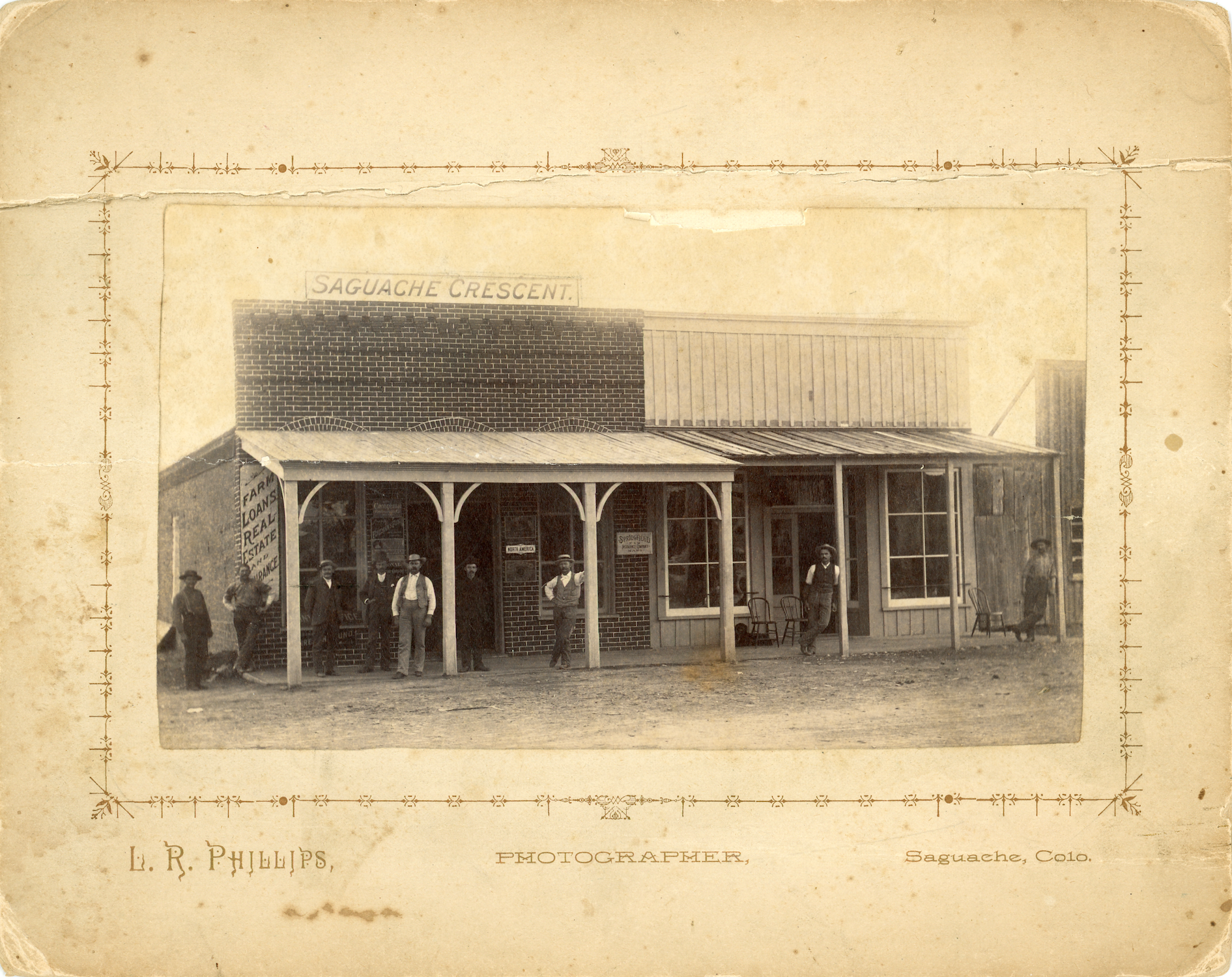
He exhibited his work at the Second Annual Fair of the Southwestern Colorado Industrial Association.  In 1890, Phillips photographed a city street in Saguache showing the office of the new Saguache Crescent newspaper, retouching his negative to add the sign for the paper.  At times, Phillips taught school in addition to his photographic work.  Phillips closed his Saguache photo studio on October 31, 1890, and moved to Aspen to assist in his brother’s hardware business.

L. R. Phillips, photographer. Saguache Street Scene, 1890; Denver Public Library

By 1892, Phillips lived in Roswell, New Mexico where he operated a photography studio, Phillips & Sheek.  Sheek’s first name is unknown, but the team made photographs that were displayed at the 1893 World’s Columbian  Exposition in Chicago.  Their photographs focused on the Alfalfa Palace, constructed from 2,500 bales of alfalfa and built for the Southeastern New Mexico and Pecos Valley Fair held in October 1892.  He married Ola Lee Fountain in Chaves, New Mexico on August 12, 1894.

Phillips returned to Colorado in the late 1890s, settling in Grand Junction where he continued to make studio portraits until 1899 when he sold his studio.  Phillips remained in Colorado for the next fifteen years working as a school principal and serving as town treasurer of Fruita.  He patented a globe for teaching geography, a fire kindler, and an oscillating water motor.

By 1930, Phillips lived in Los Angeles and was employed in the insurance industry.  He died on December 3, 1944, leaving a wife and five children.

Thanks to Beverly Brannan, recently retired Curator of Photography, Library of Congress for editing assistance and Karen Hendrix for pointing out the painted backdrop.