George Mellen arrived in Gunnison, Colorado in 1880 and immediately began making finely composed stereoviews and boudoir cards of the new and growing town. A few years later, Mellen worked for the renowned landscape photographer, William Henry Jackson in Denver, Colorado. This post will try to answer several questions about his early life.
When was George E. Mellen born? George was the eldest child of Morris Mellen and Serepta Walkup Mellen. His younger brother, William, was about two years younger than George. Their mother died in September 1854.
Census records can help determine a birth date, but they are not entirely reliable, as we will see below. The closer the census date is to the birth date, the more likely it is to reflect reality. The 1855 census, which is the first time George appears in a census, shows him as three years old, allowing us to assume that he was born circa 1832.

The 1900 federal census provides a birth month and year, but frequently contains inaccurate information. For example, George’s birth date is given as February 1855.

Where did he learn the photographic trade? By 1870, the Mellen family lived on a farm in Franklin County, Kansas. After a brief time in New York, Mellen considered a teaching career; however, by 1879, he discovered his true passion for photography. Apprenticing with veteran photographer, Alvin W. Barker, in Ottawa, Kansas, Mellen was soon traveling the countryside with Barker’s view wagon making photographs of schools, public squares, and farmer’s homes a “thing of beauty and a joy forever.”

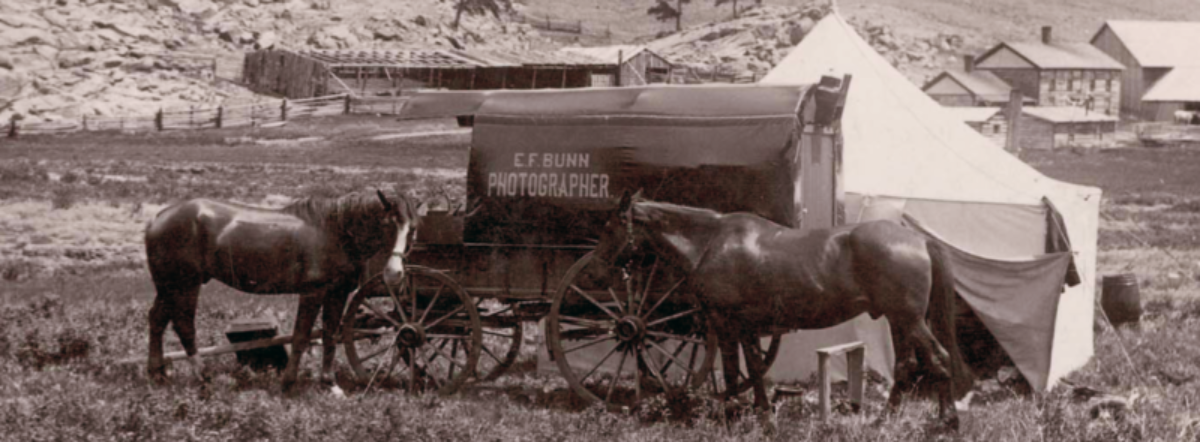
On the road to Colorado. Barker, a seasoned traveler who had made two trips to Colorado in the 1870s, accompanied Mellen. Barker wrote numerous lengthy trip essays under the title “Westward Ho!” that were published in the Ottawa papers. The first one described their wagon:

“Our outfit, perhaps will need but very little description, as most of Franklin Co. have become familiar with its appearance as a view wagon. The wagon is lightly constructed, two Texas ponies as the propelling power, and the most interesting driver that ever drew reins over the back of a Texas thoroughbred. At first sight he would be called rather lengthy, especially when he takes his position for business upon the front end of the ambulance, and throwing his legs over the dashboard, there not being room inside to contain them when unwound; his likeness has been painted at great expense upon the rear end of the wagon, which is as correct as the best artist in Ottawa could make a shadow, with one exception, his feet are a little out of proportion, owing to his being out of the city when the artist was about to put on the finishing touches…”
The essays provide entertaining and informative details, mentioning nearly every town they pass through, and give details about population, businesses, weather, crops, and prospects for farming and ranching on the land. The 700-mile trip took 2-1/2 months. The team arrived in Gunnison in the middle of June.

Mellen stayed in Gunnison and Barker returned to Ottawa, Kansas, possibly via rail as the Denver & Rio Grande had just started operation from Salida in May 1880.
Thank you to Jori Johnson and Aaron Marcus at History Colorado and Kellen Cutsford, Denver Public Library. Jerilyn Marshall assisted with biographical information to be published later.

