Researching George Mellen’s Journey to Colorado

George Mellen arrived in Gunnison, Colorado in 1880 and immediately began making finely composed stereoviews and boudoir cards of the new and growing town.  A few years later, Mellen worked for the renowned landscape photographer, William Henry Jackson in Denver, Colorado.  This post will try to answer several questions about his early life.

When was George E. Mellen born?                                                                                   George was the eldest child of Morris Mellen and Serepta Walkup Mellen.  His younger brother, William, was about two years younger than George.  Their mother died in September 1854.

Census records can help determine a birth date, but they are not entirely reliable, as we will see below.  The closer the census date is to the birth date, the more likely it is to reflect reality.  The 1855 census, which is the first time George appears in a census, shows him as three years old, allowing us to assume that he was born circa 1832.

1855 census
New York State Census, Gerry, Chautauqua County, 1855, enumerated on June 6, 1855

The 1900 federal census provides a birth month and year, but frequently contains inaccurate information.  For example, George’s birth date is given as February 1855.

1900 federal census
1900 Federal census, for Chicago, IL

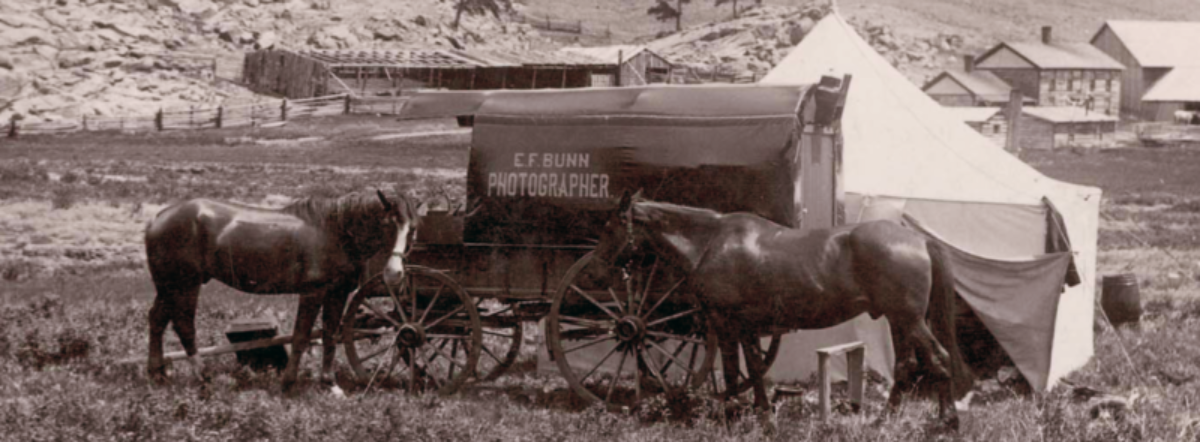
Where did he learn the photographic trade?                                                                    By 1870, the Mellen family lived on a farm in Franklin County, Kansas.  After a brief time in New York, Mellen considered a teaching career; however, by 1879, he discovered his true passion for photography.  Apprenticing with veteran photographer, Alvin W. Barker, in Ottawa, Kansas, Mellen was soon traveling the countryside with Barker’s view wagon making photographs of  schools, public squares, and farmer’s homes a “thing of beauty and a joy forever.”

Photo wagon
Mellen’s photographic wagon. Albumen silver stereo view. History Colorado

On the road to Colorado.                                                                                                   Barker, a seasoned traveler who had made two trips to Colorado in the 1870s, accompanied Mellen.  Barker wrote numerous lengthy trip essays under the title “Westward Ho!” that were published in the Ottawa papers.  The first one described their wagon:

Detail of stereo.

“Our outfit, perhaps will need but very little description, as most of Franklin Co. have become familiar with its appearance as a view wagon.  The wagon is lightly constructed, two Texas ponies as the propelling power, and the most interesting driver that ever drew reins over the back of a Texas thoroughbred. At first sight he would be called rather lengthy, especially when he takes his position for business upon the front end of the ambulance, and throwing his legs over the dashboard, there not being room inside to contain them when unwound; his likeness has been painted at great expense upon the rear end of the wagon, which is as correct as the best artist in Ottawa could make a shadow, with one exception, his feet are a little out of proportion, owing to his being out of the city when the artist was about to put on the finishing touches…”

The essays provide entertaining and informative details, mentioning nearly every town they pass through, and give details about population, businesses, weather, crops, and prospects for farming and ranching on the land.  The 700-mile trip took 2-1/2 months.  The team arrived in Gunnison in the middle of June.  

map
Mellen’s route between Ottawa, Kansas, and Gunnison, Colorado.

Mellen stayed in Gunnison and Barker returned to Ottawa, Kansas, possibly via rail as the Denver & Rio Grande had just started operation from Salida in May 1880.  

Thank you to Jori Johnson and Aaron Marcus at History Colorado and Kellen Cutsford, Denver Public Library.  Jerilyn Marshall assisted with biographical information to be published later.  

Everett Van Epps, Kansas Photographer and Publisher, Moves to Alma, Colorado

With this post, we are going to cross over to the 20th century, to look at the work of Everett Van Epps (1858-1935), a photographer active in Alma, Colorado, in the late 1890s until his death.  The Pikes Peak Library District in Colorado Springs has a small archive of modern prints made from Epps’ original negatives.

photo car
E. E. Van Epps Photo Gallery, probably in Hoxie, Kansas, 1888, Pikes Peak Library District

Everett E. Van Epps was born on a farm in Fremont, Iowa, on April 28, 1858, to Evert and Janett Van Epps.  Everett pursued many professional careers during his long life, but his interest in photography never wavered. He began his photographic career in 1879 working out of a railroad car in Scandia, Kansas.

In 1884 he opened a studio in a brand new building in Hanover, KS.   Everett traveled to New Orleans in January 1885,  studying photography at the  World’s Industrial and Cotton Centennial Exposition.  (Grit, February 27, 1885, p6, c1)

Everett moved his operation to Oberlin, KS, in 1886 and opened a series of studios in northwestern part of the state.  He juggled as many as four studios at a time, including locations in Atwood, Colby, Hoxie, and Sharon Springs. He also traveled with his outfit to several other cities in the state.

Girls in newspaper
E. E. van Epps, Cabinet Card, circa 1888, Courtesy of Worthpoint

During the early 1890s Van Epps published The Selden Times, The Colby News and The Dresden Star,  while maintaining his photo business.  In September 1890 he traveled with other Kansas newspapers editors to Colorado.  From Colorado Springs, they took a special Pullman car on the Colorado Midland to the Continental Divide, and then to Glenwood Springs and Denver before taking the Rock Island back to Kansas.

In 1892 Van Epps began working a mining claim near Colorado’s Cripple Creek, while maintaining is home in Kansas.  The following year, Van Epps worked in the photography department at the World’s Columbian Exposition in Chicago, where he printed a record 1260 pictures in a single day.  (The Pittsburg Daily Headlight, September 12, 1896, p4, c7)

Van Epps moved permanently to Alma, Colorado, in 1898. He opened a photo gallery and also worked the Wood Chuck mine on Mt. Democrat for molybdenum.  (The Colby Tribune,  January 26, 1899, p8, c3)

In the 1920s,  Van Epps used a panoramic camera to photograph mining camps in Park County, Colorado.  Copy photographs from Van Epps’s original negatives can be viewed here: http://digitalcollections.ppld.org/digital/collection/p15981coll11

Van Epps Mine
E. E. Van Epps. Van Epps Placer Claim, circa 1925. Pikes Peak Library.

Van Epps died on August 30,1935 from an accidental powder blast at his placer mine.  He is buried in Buckskin Cemetery at Alma, CO.