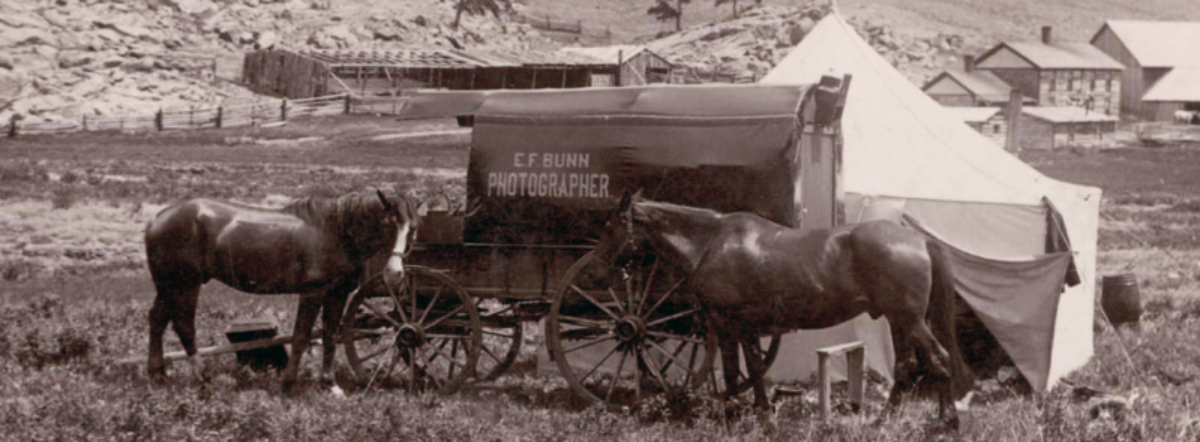
Kathy Gibson wrote this blog post about her great-grandfather, Frank Xavier Gonner.

A twenty-year old man from Luxembourg arrived at New York’s Castle Garden September 2, 1880, speaking French, German, Luxembourgish, and Latin. He was a well-educated gardener like his father, who intended his only son’s future to be the priesthood or the German Army. Frank Xavier Gonner did not want either occupation. He sought out one uncle in Dubuque, Iowa who published a magazine for Luxembourgers in America and wrote a book titled Luxembourgers in the New World. Frank traveled west to Denver, Colorado, where his other uncles Jean-Pierre and Matthias-Prosper, had a nursery business, offering flowers and winter vegetables.
Frank left them in about 1883 and followed the railroad south to Santa Fe, New Mexico; he became a vegetable grocer. He spent a few years there with several partners but by 1887 he followed the railroad northwest to Durango, Colorado. He roomed with the A. J. Faris family from Clinton, Missouri. His whole world changed in 1888 when he met the family’s half-sister, Hattie Estelle Roberts, and her father, William Henry Roberts.
Durango in the early days resembled Luxembourg, with farmlands, rolling high hills, and a river running through it. But it was a growing frontier town, filled with people from all over the world: miners, railroad men, bankers, farmers, families, and Civil War veterans. William Henry Roberts and his partner Anson Corey, both photographers from Missouri, trained Gonner in portraiture in 1889.
Gonner married Robert’s daughter in June 1891. They spent their honeymoon in Silverton. The couple had three children and the third died after birth and his wife died ten days later in June 1897.

After a large section of Durango burned in July 1889, Gonner & Leeka created a photographic collection of new buildings and homes to promote the rebuilt town. Their second collection consisted of 69 views of artifacts excavated from the 1891 Grand Gulch expedition, but these photographs have been lost to history. Grand Gulch is in southeast Utah with many canyons filled with small communities of the Ancestral Puebloans.
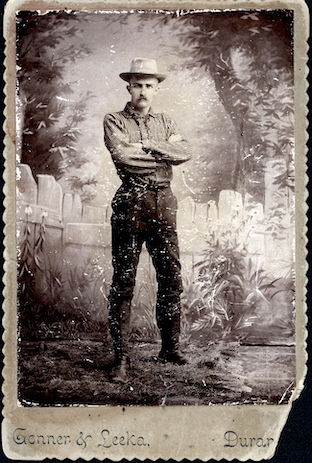
In July 1891 Gonner took his well-known portrait of Gustaf Nordenskiold, the Swedish archaeologist. He also photographed artifacts from a second Utah expedition in 1892. In the years 1889 and 1893 Gonner suffered two personal fire losses.
The Denver Camera Club awarded Gonner first prize in 1897 for a portrait of William Wallace, called “Navajo Bill”. Wallace was a pharmacist from Oregon who, at the insistence of his brother in Animas City, moved to the Durango/Farmington area in 1883 to heal from tuberculosis. He became a trader of Navajo goods.

Gonner produced important historical photographs, many portraits of the townspeople, the fire department, the local brass band, of which he was a member, the Durango Wheel Club, miners’ groups, school children, graduation classes, the local Southern Ute chiefs, the railroad, smelters, and his family.
David Day, editor of the Durango Democrat, published several special newspaper editions using Gonner’s photographs. The largest, published in 1901, featured Durango and her business residents. Together these men also displayed a photographic collection of those original San Juan County Pioneers, displayed at the Democrat office and the Gonner gallery. He sold Kodak cameras at his gallery and offered photo-processing. After purchasing a music store in 1907, he sold pianos, sheet music, and musical instruments.
He played the B-flat baritone in the Woodman Band. He had membership in benevolent fraternal groups: the Durango Elks (he was the Exalted Ruler in 1909-10), the Ancient Order of United Workmen, the Ancient Order of the Pyramids, the Fraternal Mystic Circle, and Woodmen of the World.
Several factors may have contributed to his decision to end his life in a box car on a cold February night in Silverton in 1912. He was deeply in debt. His music store partner, a piano salesman, left their business in 1911. In January 1912 the building he had rented for almost 20 years, along with lots owned by the Elks on one block on Main, were sold to the federal government for the new Durango federal building and post office. After his death his entire gallery inventory was sold to pay his debts. His nearly adult children, under guardianship, received only the benefits from his W.O.W. and Mystic Circle life insurance. He is buried with his family at Greenmount Cemetery, Durango. The post office wasn’t completed until 1929.

Frank Gonner is best remembered for his photograph of the Durango Wheel Club picnic dated June 16, 1895. The members stand with their bicycles on Baker’s Bridge north of Durango, which spans the Animas River. In 1995 the Animas Museum in Durango printed a commemorative poster for the 100th anniversary of the Bicycle Club. It is still available for purchase.
Kathy Gibson was born in CA but raised in Colorado, not knowing much about her heritage. She received an old trunk full of family memorabilia, obituaries, and photographs in 1986 and has been researching ever since. She now lives in Michigan with her daughter and husband, a fellow genealogist, and they return to Durango each year for more research. She is the family genealogist and writes about her great-grandfather and his photography, his friends in Durango, and her family’s history for the years 1881-1912. The Animas Museum in Durango invited Kathy to give a zoom talk on Frank Gonner in 2022.
Thank you to Mack Frost, Rights & Reproductions, McCracken Research Library, Buffalo Bill Center of the West for providing the scan of Navajo Bill. Beverly W. Brannan, former photography curator at the Library of Congress, Prints & Photographs Division, kindly proof-read this post.

Kathy, this answers the Durango question you left in 2019 on the Denver library’s “Is this the First Photograph of Denver?” post, put where it belongs.
The business record narrows the three men to a window and no further. Roberts and Corey leased A. E. Wilder’s gallery in November 1888 (Animas Museum, “Basic Frank Gonner Timeline” PDF), and Wilder’s own row in the “Photographers in Durango” sheet (swcogen.homestead.com) says that studio burned in the 1889 fire. The fire was 1 July 1889. The 1890 Colorado State Business Directory then lists the firm as “Cory and Gonner, photographers”, not Corey and Roberts, and Corey sold his photographic equipment in Durango in December 1889, with Gonner and Leeka following in 1891.
So for a view made after the fire, the printed record puts Gonner on the gallery door with Corey, while Roberts was still in town (1888 to 1892) but not under that firm name. That is as far as paper goes. Which of the two actually opened the shutter on a particular plate is settled only by the mount: an imprint, or a signature on the print.
Your “Durango After the Big Fire, 1889” carries nothing on the mount or the back? If the print is still in the family trunk, that is the one place the record cannot speak and the object still can.
Also worth keeping separate: the Gonner and Leeka project of 1891 photographed the rebuilt town, so a photograph of damage is not from that series.
The Speaker
Hi, Speaker,
My name is Kathy Gibson and I am the great grand daughter of Frank Gonner. I have been researching him since 1988. I received all the family material the family saved from that era and before. I wrote the timeline and the photographers chart.
I have not been able to address your first email to Carol, just began looking and checking my facts today.
I also have done serious genealogical research on William Henry Roberts, my great great grandfather, and his partner Anson Corey. Very interesting men who moved from Ohio as partners, to Missouri, and on to Durango, Colorado. They partnered using Wilder’s gallery and inventory, including his cards and plates. That spring Gonner became Corey’s apprentice evidently, since they are listed in the Colorado business directory for 1890. This is a portion of his story. Perhaps it will satisfy some of your concerns. Corey later in 1889 moved back to Clinton, MO and remained there for most of the rest of his life (short version). I suspect they paid for the ad but he was not in Colorado in 1890 after all. I have no photos of him, only photos he took in Clinton with his name on the verso. Roberts also did photography in Clinton, have some of his too.
Anson Corey was Frank Gonner’s first advertised photographic partner in the Denver Business Directory.
A. E. Wilder, local Durango photographer, had moved on to Fort Lewis mid-July, 1888, and that fall was selling off his stock in his gallery and home. William Henry arrived in Durango November 9, 1888. The Durango Herald mentions the partners leased Wilder’s studio in an article dated December 23. They were “turning out some excellent work” years experience and do all kinds of India ink and crayon work.”
At some point in 1889 William and Anson began to train Frank Gonner in the business. Later ads for Frank indicate this was the year he established his business. In April 1889 Corey returned to Clinton to care for his ailing father but returned to Durango in May. A December 1889 newspaper clipping from the Clinton Eye shows he sold his equipment to someone in Durango and returned to Clinton. Did he sell to Frank? In addition to working with Frank, Corey, Jacob Boston, and Edwin Wilder are listed in the state directory working in Durango. In 1890, Cory and Gohner are in the state directory, so is Boston, but not Wilder. In the 1892 Durango city directory, Corey is not listed as a resident and Gonner has several new but separate partners, Leeka in 1890-91 and Hurd, 1891-92.
The big fire devastated thriving Durango July 1, 1889.
Regarding the fire photo, I own that original. The only original or copy I have ever seen. I allowed the Animas Museum to copy it. It has been published a number of times and on the internet. There is nothing on the back or front, except what I believe to be my grandmother’s handwriting, Gonner’s daughter. Roberts might very well have taken the photo, Corey might have too, but I suspect Gonner took it. That was in 1889 and his later advertising in the newspaper shows he began his photography work in 1889.
We will never know unless further evidence shows the man who took the photo.
I also know a great deal about the photographs Gonner & Leeka took in 1891 to promote Durango after the town recovered from the fire. I have a number of the original cards and gave some duplicates to the museum around 1989. The Center of Southwest Studies also has some of them, and the Denver Public Library.
I hope this satisfies your concerns.
Kathy Gibson
Great granddaughter of Frank X. Gonner, 1860-1912
“and many are the dead men too silent to be real” ~ Gordon Lightfoot